
Blood in Stool: Causes, Warning Signs, and Piles vs. Fissure Differences
· Updated
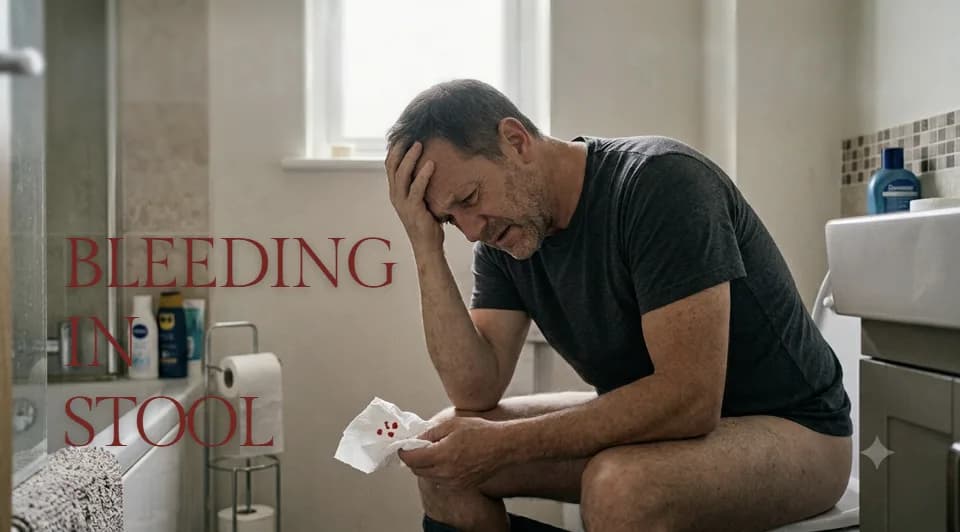
Noticing bright red blood in your stool or toilet paper? Understand common causes like piles and anal fissures, self-care steps, and when you should get evaluated by an anorectal specialist in Ahmedabad.
BLOOD IN STOOL: CAUSES, WARNING SIGNS, AND PILES VS FISSURE
Finding bright red blood during bowel movements is common, but identifying the exact cause early ensures rapid relief and prevents complications.
COMMON CAUSES OF RECTAL BLEEDING
1. INTERNAL PILES OR HEMORRHOIDS Primary feature: Swollen veins inside the lower rectum or anal canal. Symptom pattern: Typically painless, bright red bleeding seen as drops or splashes. 2. ANAL FISSURE Primary feature: A small tear in the delicate lining of the anal verge. Symptom pattern: Intense, sharp cutting pain accompanied by streaks of bright blood. 3. ANAL FISTULA Primary feature: An infected channel between the anal canal and external skin. Symptom pattern: Intermittent pus discharge, skin irritation, and blood spots. 4. PERIANAL ABSCESS Primary feature: A painful collection of pus near the anal opening. Symptom pattern: Throbbing localized pain, swelling, fever, and tender redness. 5. COLORECTAL POLYPS OR INFLAMMATION Primary feature: Tissue growths or inflammatory conditions of the colon. Symptom pattern: Blood mixed directly within the stool and changes in bowel routine.
PILES VS FISSURE: KEY CLINICAL DIFFERENCES
1. PAIN INTENSITY Piles: Usually painless in initial stages. Fissure: Sharp, intense, knife-like pain during defecation. 2. DURATION OF DISCOMFORT Piles: Mild heaviness or irritation after passing stool. Fissure: Burning or throbbing sensation that persists for hours. 3. BLEEDING PATTERN Piles: Fresh blood dripping or pooling in the pan. Fissure: Scant, bright red streaks noticeable on hard stool or toilet paper. 4. PHYSICAL SENSATION Piles: Sensation of a soft lump or incomplete evacuation. Fissure: Severe sphincter muscle tightness, burning, and spasms.
WARNING SIGNS THAT REQUIRE IMMEDIATE EVALUATION
Point 1: Bleeding that continues beyond three days or recurs repeatedly. Point 2: Dizziness, generalized weakness, or unusually pale skin. Point 3: Dark maroon, black, or tar-colored stool. Point 4: A painful swelling or protruding tissue that does not recede. Point 5: Inability to sit or walk comfortably due to severe pain. Point 6: Unexplained weight reduction or sudden alteration in stool consistency.
AT-HOME MEASURES BEFORE YOUR CONSULTATION
1. FIBER INTAKE Eat plenty of green vegetables, whole grains, and psyllium husk to soften stools. 2. HYDRATION Maintain two to three liters of water intake daily to prevent hard stools. 3. SITZ BATH Soak in a tub of plain warm water for ten to fifteen minutes twice daily to relieve spasms. 4. TOILET HABITS Avoid straining and avoid sitting on the toilet seat for prolonged durations.
CLINICAL CARE AT AARAVYA HOSPITAL
Aaravya Hospital provides comprehensive anorectal care focused on precise evaluation and quick recovery.
Feature 1: High-definition digital video proctoscopy for clear diagnostic confirmation. Feature 2: Conservative medical regimens for early-stage fissures. Feature 3: Advanced diode laser procedures for Grade 2 to 4 hemorrhoids with minimal discomfort. Feature 4: Daycare treatment protocols designed for rapid return to daily routine.
FACILITY DETAILS
Hospital: Aaravya Hospital Address: Floor 208, 3rd Floor, Swagat Status 1, Above Eat Punjab, New C.G. Road, Chandkheda, Ahmedabad, Gujarat 382424 Navigation: Search Aaravya Hospital Chandkheda on Google Maps for direct directions, doctor consultations, and appointment bookings.
- Blood in Stool Causes
- Piles Symptoms
- Anal Fissure vs Piles
- Ano-Rectal Specialist Ahmedabad
- Chandkheda Hospital
- Dr Deep Prajapati
- Digestive Health
Reviewed By

Dr. Deep Prajapati
B.A.M.S., M.S